Why Countertop Seams Exist — And What aGood Seam Actually Looks Like
Of all the aspects of a countertop installation that homeowners worry about, seams are consistently among the top concerns — and consistently among the least understood. The question "will there be a seam?" is almost always followed by a slight wince, a note of anxiety, as though a seam is inherently a flaw to be apologized for rather than a structural reality to be managed with skill.
This anxiety is understandable. A poorly executed seam is one of the most visually jarring elements in an otherwise beautiful countertop installation — a misaligned, gaping, or poorly colored joint between slabs that draws the eye immediately and communicates compromised craftsmanship. But a
well-executed seam is something most guests in your kitchen will never notice, even knowing to look for it. The difference between those two outcomes is not luck — it is expertise, planning, and the quality of the fabrication process.
Here is everything you need to understand about why countertop seams exist, where they are placed, what determines their quality, and how to evaluate whether the seams in your installation are truly excellent or merely acceptable.
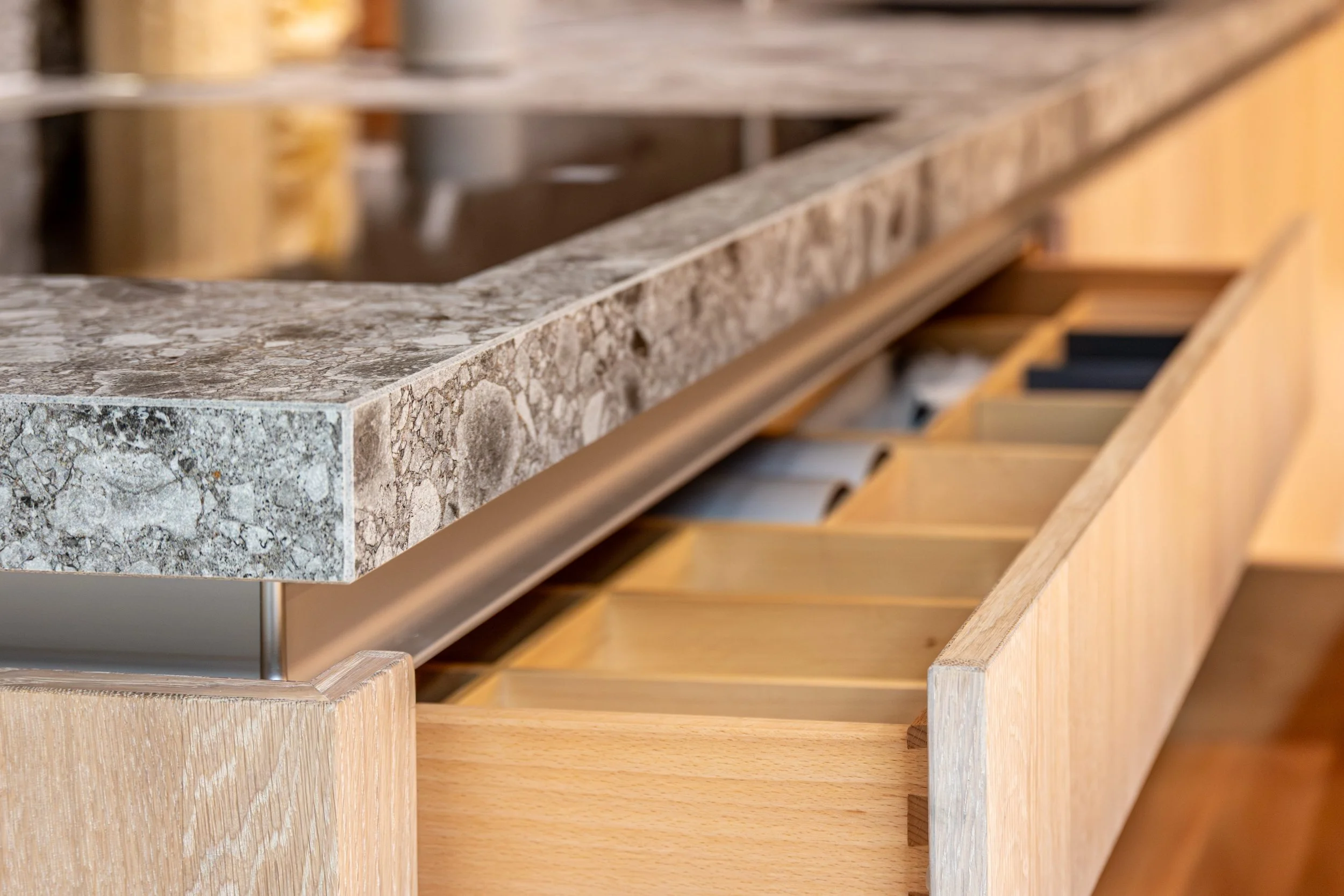
Why Seams Are Structurally Unavoidable in Most Kitchens
Natural stone slabs are quarried from blocks of rock that have specific dimensional limits determined by the geological formations from which they are extracted and the logistics of international shipping. Standard slab sizes for most natural stones range from approximately 55 to 65 inches in width and 100 to 130 inches in length — with significant variation depending on material, quarry, and supplier.
Most kitchen countertop installations involve L-shaped, U-shaped, or galley configurations where the total linear run of counter surface exceeds what a single slab can cover without piecing. An L-shaped kitchen with a 10-foot perimeter run and a 4-foot return, plus a 6-foot island, will require a minimum of two to three slabs in virtually any natural stone. A U-shaped kitchen with a large island will require more.
Even in situations where a single slab could theoretically cover the full run, there are often structural reasons to use multiple pieces — very long overhangs require additional support from below, the natural stress behavior of stone under thermal cycling is better managed with expansion joints at certain intervals, and the practical logistics of transporting and installing very large slabs in finished spaces with limited access can make smaller, jointed pieces the right engineering choice.
For engineered quartz and porcelain, the manufacturing process produces more consistent slab " sizes, but the same basic reality applies — large kitchens require multiple slabs, and multiple slabs require seams. Understanding this from the outset allows you to have a productive conversation with your fabricator about placement and management rather than a disappointing surprise after installation.
Key Point: A seam in a well-designed and well-executed installation is not a flaw — it is a structural joint managed with skill. The goal is not to eliminate seams but to place them thoughtfully and execute them with precision.
The Art and Science of Seam Placement
Where a seam is placed within a countertop layout is one of the most consequential decisions in the entire fabrication process — and one of the clearest differentiators between experienced fabricators and less skilled ones. Seam placement involves balancing several competing considerations simultaneously:
• Structural integrity: Seams should never be placed over empty cabinet space without support beneath them. They should be located over a cabinet wall, frame member, or other structural support that prevents the joint from being stressed by downward pressure.
• Sightline management: The most visible areas of a countertop from the room's main vantage points — typically the entry, the dining area, or the opposite side of a kitchen island — should ideally be seam-free. Placing seams in areas that are less visually prominent (near a wall, at an inside corner, at the back of a deep counter run) minimizes their impact.
• Pattern and vein alignment: In a veined natural stone like marble or quartzite, the seam should ideally be placed within a vein or at a natural break in the pattern — a location where the join can be camouflaged by the stone's own design rather than sitting across an open field of color where it will be obvious.
• Material economy: Slab cuts that minimize waste reduce cost and environmental impact. An experienced fabricator finds seam placements that satisfy structural and aesthetic requirements while also making efficient use of the raw material.
• Sink and fixture proximity: Seams should generally not be placed immediately adjacent to sink cutouts or other stress points where water exposure and mechanical use are concentrated. A seam near a sink that is not perfectly sealed will eventually admit moisture.
What a High-Quality Seam Actually Looks Like: The Five Standards
If you want to evaluate the quality of a seam — either in your own completed installation or in sample work from a fabricator you're considering — here are the five specific attributes of an excellent seam:
1. Level Surface Alignment
The surfaces of both slabs on either side of the seam should be perfectly level with each other — no lip, no step, no perceptible height difference when you run your finger across the joint. Even a half-millimeter step between slabs at a seam is immediately perceptible to touch and, under certain lighting, to the eye. Achieving perfect surface alignment requires precision in both the template measurement and the installation process, including meticulous shimming and leveling of the cabinet surfaces below.
2. Tight Gap with Proper Epoxy Fill
The gap between the two stone edges at a seam should be as narrow as the fabrication process allows — typically no more than 1/16 to 1/8 inch in natural stone, often tighter in engineered materials. This gap is filled with color-matched epoxy that is mixed specifically to match the background color of the stone at the joint location.
A wide, uneven gap filled with imprecisely matched epoxy is one of the most common indicators of below-average fabrication. A tight gap with epoxy that blends seamlessly into the stone surface — so that running your eye across the seam you must look carefully to find it — is the hallmark of a skilled installation.
3. Color-Matched Epoxy
The epoxy used to fill the seam joint is mixed from a palette of pigments to match the specific color of the stone at the joint. This is not a generic grey or beige filler — it is a custom color match made for that specific seam location on that specific slab. The better the match, the less the eye perceives a transition.
In a veined stone like marble or quartzite, skilled fabricators will sometimes use multiple epoxy colors within the same seam — matching the background, the vein color, and any secondary tones — to create a result that reads as a continuous stone surface rather than a joint.
4. Pattern Continuity Where Possible
In a bookmatched installation — where two consecutive slabs from the same block are mirrored across a seam — the veining pattern flows continuously from one slab to the other in a symmetrical, visually deliberate way. This technique, most commonly used with dramatically veined marbles and quartzites, transforms the seam from a practical joint into a design feature: a mirror-image unfolding of the stone's geological structure.
Even in non-bookmatched installations, a skilled fabricator will select and orient slabs so that the vein direction, color distribution, and overall movement of the stone reads as continuous across the seam rather than abruptly different.
5. Clean, Finished Epoxy Surface
After the epoxy cures, the joint surface should be cleaned, polished, and finished to match the surrounding stone surface — no raised ridges, no epoxy residue on the stone surface, no dull patch in the finish where the joint has been worked. The seam should feel smooth and continuous under the hand and should reflect light consistently with the surrounding surface rather than creating a dull or irregular line.
"A great seam is one you have to show a guest before they notice it. A poor seam is the first thing they see when they walk in."

The Seam Conversation You Should Have Before Fabrication Begins
One of the most valuable things you can do in the planning phase of any countertop project is to have an explicit conversation with your fabricator about seam placement — before the template is finalized and certainly before fabrication begins. Ask them to show you on the floor plan exactly where seams will be placed and why. Ask them to explain their epoxy color-matching process. If possible, ask to see examples of their seam work in completed installations.
A fabricator who welcomes this conversation, explains their seam placement reasoning clearly, and can show you actual examples of high-quality seam work is a fabricator you can trust. One who dismisses seam concerns or cannot provide concrete examples of their seam quality is giving you important information about the level of craftsmanship you should expect.
| Seam Quality Indicator | Poor Quality | High Quality |
|---|---|---|
| Surface alignment | Visible/tangible step between slabs | Perfectly flush, imperceptible to touch |
| Gap width | Wide, uneven gaps | Consistently tight — 1/16" or less |
| Epoxy color match | Generic grey/beige, obviously different | Custom-mixed, blends with stone |
| Pattern continuity | Abrupt pattern change at joint | Vein direction and flow maintained |
| Epoxy finish | Ridges, residue, dull patch | Clean, polished, surface-consistent |
| Placement logic | Random, convenient for fabricator | Structural + visual rationale explained |
How to Work with a Fabricator Who Treats Seams as a Craft Detail
The single best predictor of seam quality is fabricator experience and attention to detail. High-volume shops processing dozens of kitchens per week may approach seam management as a production step to be completed efficiently rather than a craft decision to be made thoughtfully. Smaller operations with deep experience and a genuine investment in quality tend to treat seam placement and execution as one of the defining measures of their work.
Look for fabricators who discuss seam placement proactively rather than reactively, who can show you their epoxy color-matching process, who use digital templating for maximum precision, and who have a portfolio of completed work that you can examine for seam quality in real installations.
East Coast Surfaces approaches seam placement and execution as a genuine craft detail — one that reflects directly on the quality of the entire installation. Every project involves explicit seam planning as part of the design process, precision digital templating, custom epoxy color-matching, and a final quality review before any installation is considered complete. View completed projects in the gallery to see the quality of their seam work in real installations, explore all surface options, and contact the team to discuss your project — including exactly where seams will be placed and why.