Your kitchen is the heart of your home. It's where mornings begin, meals are made, and memories happen around the table. And when it comes to defining the look and feel of that space, few decisions carry more visual weight than your countertop choice — not just the material, but the design style itself.
Three of the most popular approaches right now are the waterfall island, the slab backsplash, and the classic standard countertop. Each creates a distinctly different aesthetic, comes with its own set of practical considerations, and fits different budgets, lifestyles, and design visions.
The Waterfall Island: Bold, Modern, and Unmistakably Luxurious
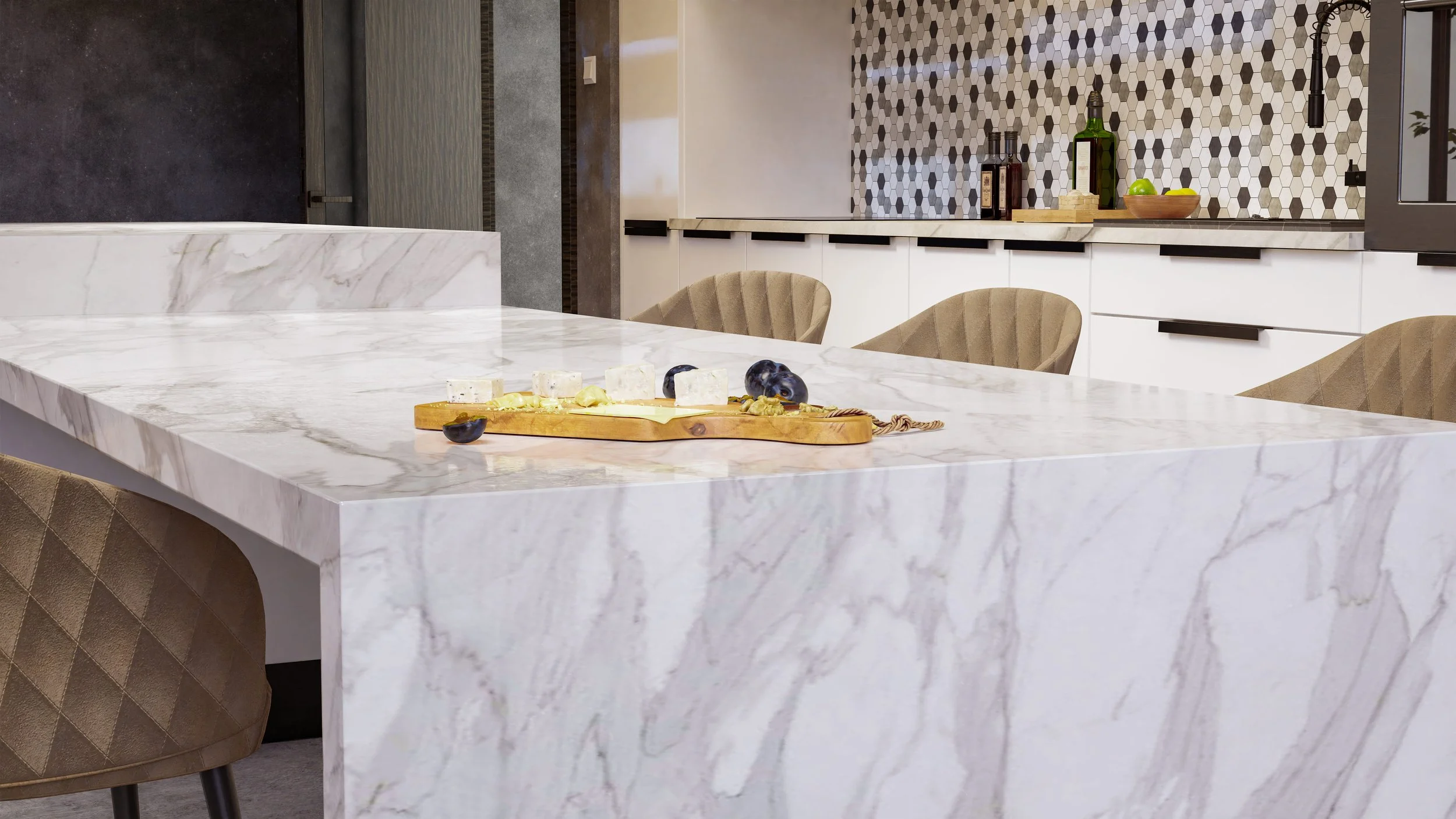
If you've scrolled through any kitchen design inspiration lately, you've seen the waterfall island. It's the style where the countertop material doesn't stop at the edge of the island — it continues vertically down the sides, all the way to the floor, creating a seamless, uninterrupted "waterfall" of stone or material.
The result is dramatic. It transforms a functional kitchen island into a sculptural centerpiece — something that feels less like furniture and more like architecture.
Why homeowners love it: The waterfall island signals luxury without requiring a full kitchen renovation. If you have a beautiful slab of quartz, quartzite, or marble with striking veining, a waterfall application lets that natural movement and pattern flow continuously from the top surface down the sides. The visual effect is stunning, especially when the slabs are matched so the veining continues seamlessly across the corner.
It also offers excellent protection for the sides of your island cabinetry. Instead of exposed wood or painted cabinet ends that can dent, scratch, or scuff over time, the stone wraps and shields those surfaces permanently.
Where it works best: Waterfall islands shine in open-plan kitchens where the island is visible from multiple angles — living rooms, dining areas, entryways. If your island is a focal point that people see as soon as they walk in, the waterfall justifies its premium.
What to consider: The waterfall look does come at a higher cost. You need significantly more material than a standard countertop application, and the fabrication — particularly matching the veining at the corner — requires a skilled fabricator. Not every stone will achieve the dramatic matched-vein effect; highly veined natural stones like Calacatta marble or dramatic quartzite slabs tend to produce the most jaw-dropping results.
The Slab Backsplash: Seamless, Sophisticated, and Effortless to Clean
The slab backsplash takes your countertop material and extends it vertically up the wall — from the countertop surface to the bottom of the upper cabinets, replacing the traditional tile backsplash entirely with a continuous, unbroken expanse of stone.
The effect is sleek, cohesive, and deeply intentional. Rather than the visual busyness of tile grout lines and individual pieces, you get one uninterrupted surface that makes the kitchen feel larger, calmer, and more refined.
Why homeowners love it: Beyond pure aesthetics, the slab backsplash is extraordinarily practical. No grout means no grout to scrub, no grout to discolor over time, and no grout to harbor bacteria. The entire surface — counter and backsplash — wipes clean in one smooth motion. For anyone who cooks frequently and hates cleaning, this is a genuine quality-of-life upgrade.
It also creates remarkable visual continuity. When the countertop and backsplash are the same material — whether it's a bold black granite, a soft white quartz, or a richly veined natural stone — the kitchen has a pulled-together, designer quality that's hard to achieve with mismatched materials.
Where it works best: The slab backsplash works beautifully in kitchens where the countertop material itself is the star. If you've invested in a truly beautiful stone — dramatic veining, interesting color movement, or a distinctive pattern — extending it up the wall amplifies that investment and makes sure it gets noticed.
It's also ideal for kitchens with darker or bolder countertop choices. A full slab backsplash in deep charcoal, forest green, or rich navy creates a moody, high-end atmosphere that tile simply can't replicate.
What to consider: Material continuity matters here. The slab and countertop should ideally come from the same block or be carefully matched. Mismatched slabs — even in the same material — can look disjointed when placed side by side. A skilled fabricator will book-match or carefully select complementary pieces.
Cost is also a factor, though typically less so than a waterfall island. You're adding vertical square footage of material and the fabrication work to cut and fit it precisely around outlets, switches, and windows.
Standard Countertops: Timeless, Versatile, and Endlessly Customizable
There's a reason the standard countertop has been the foundation of kitchen design for generations — it works. Beautifully, practically, and across virtually every design style imaginable.
A standard countertop runs horizontally across your base cabinets and island, stopping at the edge with a finished profile — whether that's a simple eased edge, a classic bullnose, a sophisticated ogee, or a modern mitered look. The backsplash is handled separately, giving you full creative freedom to mix materials, introduce tile patterns, and layer textures.
Why homeowners love it: Flexibility is the standard countertop's greatest strength. You're free to choose one material for the counters and something entirely different for the backsplash — subway tile, mosaic, handmade ceramic, patterned encaustic tile, or virtually anything else.
This layering of materials is how kitchens develop personality and warmth.
Standard countertops also make future updates easier and more affordable. If you decide in five years that you want a different backsplash, you can change it without touching your countertops. That modularity has real long-term value.
From a budget standpoint, standard countertops are also the most accessible. You're using less material per square foot than waterfall or slab backsplash applications, which means your material budget goes further — either toward a higher-end stone or simply toward a lower overall project cost.
Where it works best: Honestly? Everywhere. Traditional kitchens. Farmhouse kitchens. Transitional spaces. Eclectic designs. The standard countertop is the chameleon of kitchen design — it adapts to whatever aesthetic you're building around it.
Conclusion
The answer comes down to three things: your design vision, your lifestyle, and your budget. Choose a waterfall island if you want a dramatic, architectural statement piece in a modern or contemporary kitchen and you're willing to invest in premium fabrication to achieve it.
Choose a slab backsplash if you want a sleek, seamless, easy-to-clean kitchen that feels cohesive and luxurious — and you have a countertop material beautiful enough to carry the entire visual story.
Choose standard countertops if you want maximum design flexibility, the freedom to mix materials, and a timeless foundation that works with your style today and adapts as your taste evolves.
At East Coast Surfaces, we help homeowners navigate exactly these decisions — from material selection and edge profiles to fabrication and installation. Whether you're drawn to the drama of a waterfall, the sophistication of a slab backsplash, or the classic versatility of a standard countertop, we'll help you bring that vision to life with craftsmanship that lasts.
Your kitchen deserves to be exactly what you imagined. Let's build it together.