Walk into any home improvement store, browse any countertop website, or scroll through any kitchen renovation feed on social media, and you'll encounter the word "high-end" applied to everything from premium-grade natural quartzite slabs to mid-range engineered quartz with a marble-look print. The term has been stretched so far by marketing that it has nearly lost its meaning — which creates a real problem for homeowners trying to make informed decisions about one of the most significant investments in a kitchen renovation.
The truth is that "high-end" in countertops is not a vague feeling or a price tag. It is a specific combination of quantifiable factors — material origin, slab quality, fabrication precision, installation craftsmanship, and the thoughtfulness of finish and edge selection — that together produce a result that looks, feels, and performs at a genuinely elevated level for years or decades. Understanding exactly what those factors are gives you the ability to evaluate any countertop on its actual merits rather than its marketing description.
This guide breaks down each of those factors in concrete terms, so you can approach your next countertop project with clarity about what you're actually paying for — and what you're not.
Factor 1: The Material Itself — Origin, Rarity, and Geological Quality
The foundation of any high-end countertop is the material from which it is made, and within each material category there is an enormous range of quality that is not immediately visible to an untrained eye.
Take granite, for example. Granite is the most abundant igneous rock on earth — a broad category that encompasses everything from the most common, undistinguished commercial slabs sold at the lowest price tier to extraordinarily rare, visually spectacular stones quarried in limited quantities from specific geological formations in Brazil, Norway, or India. Within that category, what separates high-end granite from commodity granite includes: the rarity of the color and pattern, the clarity and sharpness of the mineral crystalline structure, the absence of fissures and inclusions that affect structural integrity, the consistency of the quarried block from which the slabs were cut, and the geographic origin of the stone.
The same principle applies to marble, quartzite, and soapstone. A Calacatta Oro marble from a specific quarry in Carrara, Italy — with its brilliant white background and warm gold veining — is a fundamentally different material from a commodity white marble with grey veining sold at a fraction of the cost. Both are technically marble. Only one is high-end.
For engineered quartz, material quality is determined by the quartz content percentage (higher is generally better), the quality of the resins and pigments used, the consistency of the manufacturing process, and the brand's investment in realistic pattern design. Premium engineered quartz from Silestone, Cambria, or Caesarstone looks categorically different from budget engineered quartz — the patterns are more complex, the depth of color is greater, and the surface has a quality of realism that cheaper products simply cannot replicate.
Material Grade Tip: When visiting a stone yard, ask specifically where a slab was quarried and what grade classification it carries. Reputable suppliers grade their natural stone inventory and can explain the quality differences between slabs in the same material category.
Factor 2: Slab Thickness — The Subtle Signal of Substance
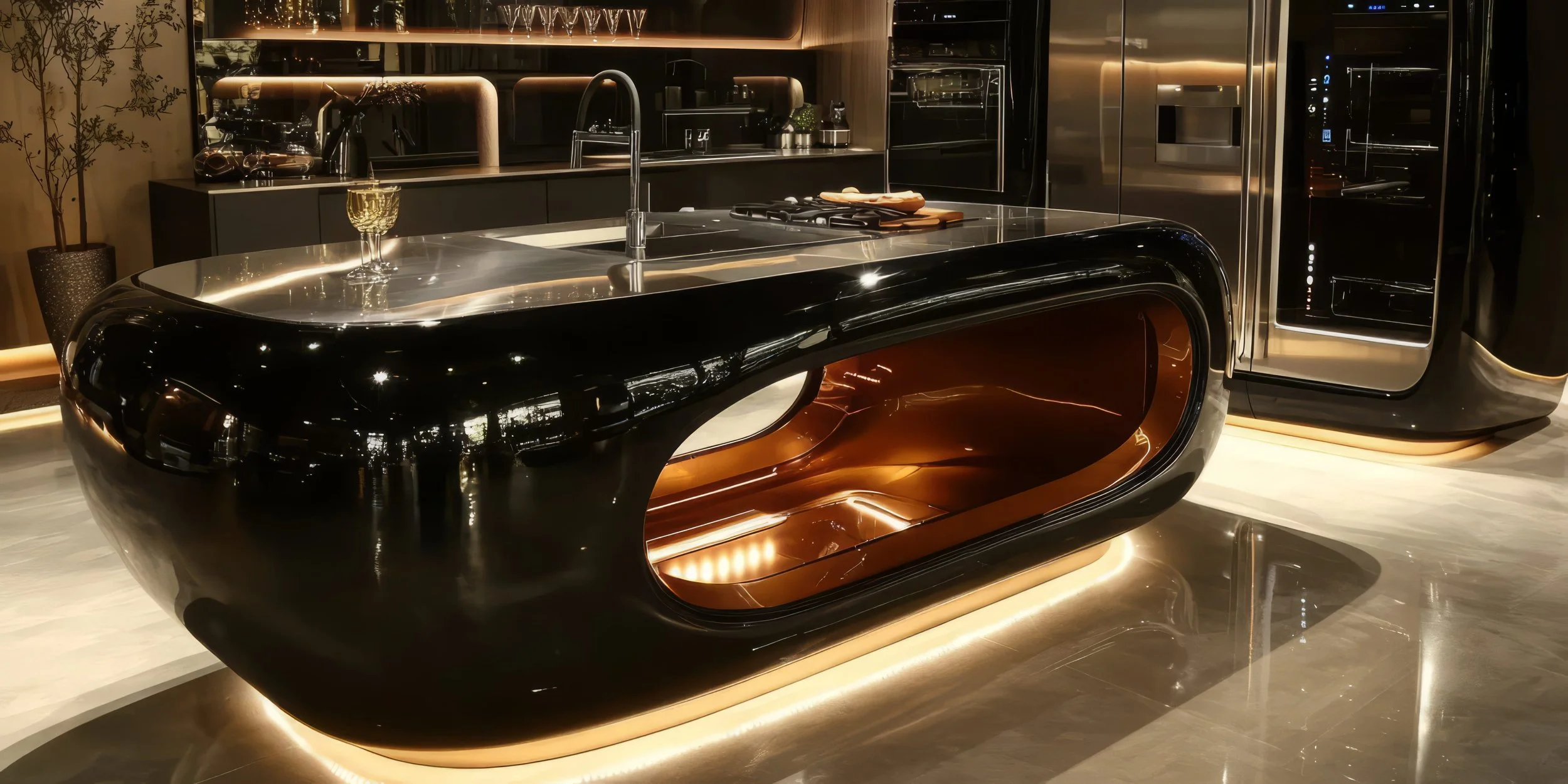
Countertop slabs are available in two standard thicknesses: 2 centimeters (approximately 3/4 inch) and 3 centimeters (approximately 1-1/4 inch). This seemingly small difference has an outsized impact on how a countertop reads visually and feels physically.
A 3CM slab has a visual weight and solidity that a 2CM slab cannot replicate. When you look at the edge of the counter — particularly at the front edge that faces the room — 3CM stone has a presence and substance that reads immediately as premium. A 2CM slab, by contrast, can look slightly thin and insubstantial unless a built-up edge (laminated strips that add the appearance of greater thickness) is applied — which adds cost and, if done poorly, introduces a visible seam at the edge that undermines the clean appearance.
High-end countertop installations almost universally use 3CM slabs. The material cost difference between 2CM and 3CM is meaningful, but the visual and structural improvement is significant enough that serious fabricators and designers default to 3CM as the baseline for premium work.
Factor 3: Fabrication Quality — Where Craftsmanship Makes the Difference
The same premium slab of Calacatta marble can produce a high-end countertop or a disappointing one depending entirely on the quality of the fabrication. Fabrication — the process of cutting, shaping, edge-profiling, and finishing the raw slab to fit a specific kitchen — is where true craftsmanship either elevates or undermines the material.
High-quality fabrication is characterized by several specific attributes:
CNC precision cutting: Computer-controlled cutting equipment produces clean, accurate cuts that fit the actual geometry of the kitchen with minimal gap. Hand-cut installations, by contrast, introduce tolerances and irregularities that become visible over time.
Consistent edge profiling: A well-executed edge profile — whether a simple eased edge or a complex ogee — is crisp, consistent, and uniform along its entire length. Variations in depth, sharpness, or profile shape are immediately visible and communicate inconsistent craftsmanship.
Polish quality: The final polish applied to the stone surface and edge should be mirror-consistent — no dull patches, no swirl marks, no variation in sheen level. This level of finish requires proper equipment and proper technique.
Cutout precision: The cutouts for sinks, cooktops, and fixtures are among the most technically demanding aspects of stone fabrication. A high-quality cutout is perfectly dimensioned, with clean corners, smooth edges, and no chipping. Poor cutouts can be concealed but not corrected.
Factor 4: The Edge Profile — Decoration or Architecture?
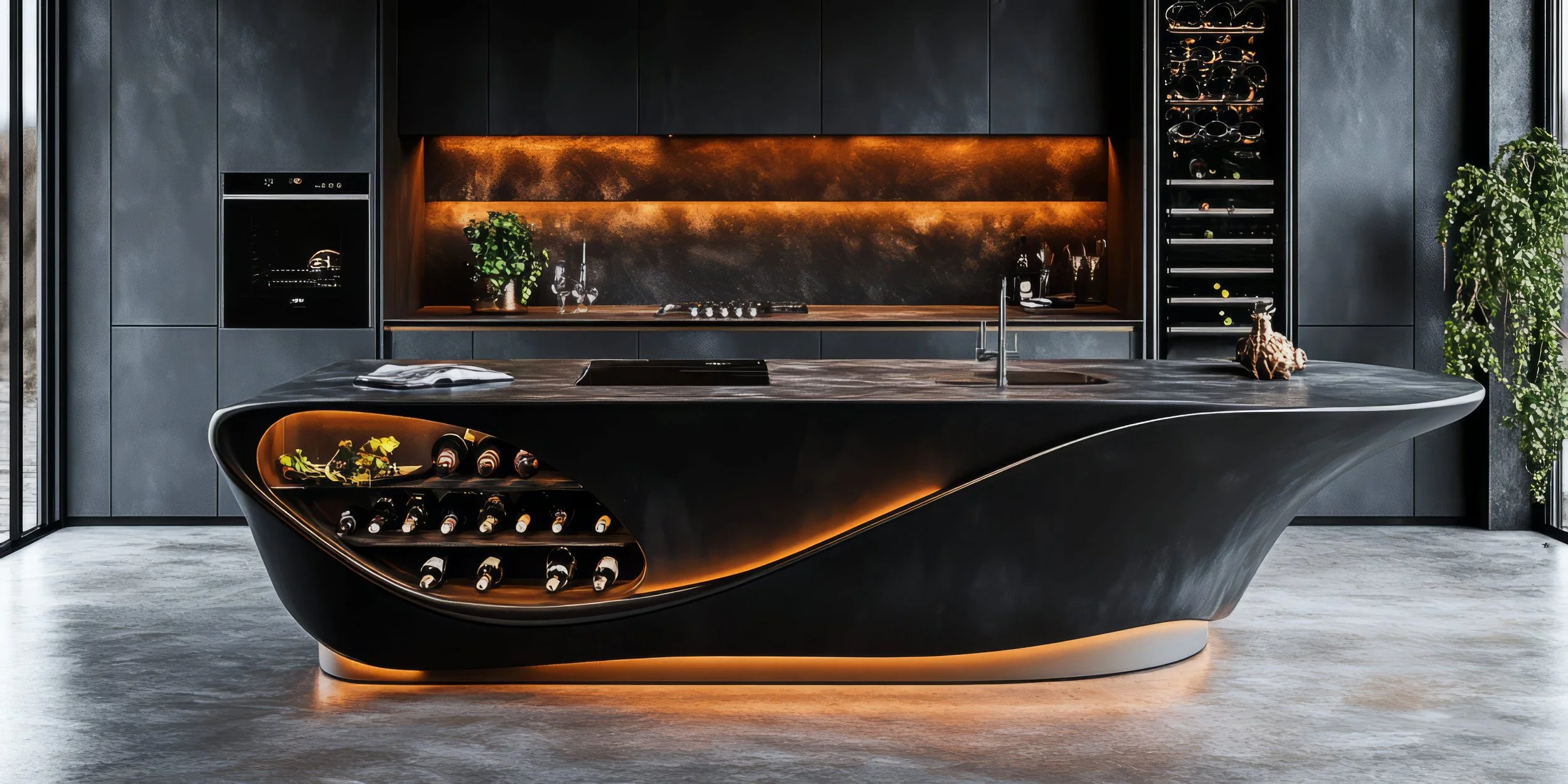
The edge profile is one of the most visible details of a countertop installation — and one of the clearest signals of the overall quality level of the project. In a high-end installation, the edge profile is chosen deliberately, as a design decision that relates to the architecture of the room, the style of the cabinetry, and the character of the stone itself. It is executed with absolute precision and consistency.
Premium edge options — the ogee, the waterfall miter, the dupont, the cove and bevel — require more material removal, more precise tooling, and more skilled finishing than a basic eased edge. They also communicate a level of investment and attention to detail that immediately elevates the perceived quality of the entire kitchen. East Coast Surfaces offers a full range of edge and corner profiles designed to complement any material and aesthetic direction.
Factor 5: Seam Management — The Invisible Hallmark of Excellence
In any installation requiring more than one slab — which includes the majority of full kitchen countertop projects — seams between slabs are unavoidable. In a high-end installation, these seams are managed with such skill that they become nearly invisible to a casual observer.
Expert seam management involves: precise matching of the stone's color and pattern across the seam, thoughtful placement of the seam at a location that minimizes its visual impact (ideally within a vein or pattern break rather than across an open field of color), perfectly level alignment of the slab surfaces across the seam, and the use of color-matched epoxy that blends seamlessly with the stone rather than drawing attention to the joint.
A poorly managed seam is one of the most glaring indicators of low-quality fabrication and installation.
A well-managed seam, by contrast, is something most guests in your kitchen will never notice.
Factor 6: Installation Precision — The Final Mile
The finest slab, perfectly fabricated, can be undermined by careless installation. High-end installation means: level and plumb placement confirmed with precision instruments, tight and consistent reveals at backsplashes and walls, properly supported overhangs without flex or bounce, clean and consistent caulking at wall transitions, and a final inspection that catches and corrects any issues before the job is considered complete.
Installation is also where the relationship between the fabricator and the homeowner is most directly felt. A high-end installation team communicates clearly, respects your home, solves problems proactively, and leaves the space cleaner than they found it.
"High-end isn't a price bracket — it's the sum of every decision, from the quarry to the caulk line, made with genuine care and expertise."
What High-End Actually Costs — and Why It's Worth It
Premium natural stone and expert fabrication carry a higher upfront cost than commodity materials and standard installation. That cost differential is real, and it would be dishonest to minimize it. But it's worth understanding what you're actually buying when you invest at the higher end of the market.
A well-executed high-end countertop installation in premium natural stone will look better at year ten than a budget installation looks at year two. It will photograph well, add genuine resale value to the home, require less ongoing remediation, and provide daily pleasure in a way that a compromised material and installation simply doesn't. In the context of a kitchen that will be used every day for decades, the cost-per-year calculation looks very different from the sticker-shock comparison at the point of purchase.
East Coast Surfaces brings every one of these quality factors — premium material sourcing from over 150 colors and stone types, precision CNC fabrication, expert installation, and a genuine commitment to craftsmanship — to every project they take on in Rhode Island. Explore the full surface collection, browse completed high-end projects in the gallery, and reach out to start the conversation about what truly high-end looks like for your specific kitchen.