What Is Dekton? Everything Homeowners Should Know Before Choosing It
If you've spent any time researching countertop materials in the last few years, you've almost certainly encountered the word Dekton — likely in a context that made it sound like some kind of countertop super-material, impervious to everything from boiling pots to UV rays to red wine and bleach. The marketing is enthusiastic, the claims are bold, and the price point is significant. So what exactly is Dekton, how is it made, what makes it genuinely different from other countertop materials, and — critically — who is it actually right for?
Let's work through this comprehensively, so you can make an informed decision rather than one based on showroom enthusiasm or manufacturer marketing.
What Exactly Is Dekton and How Is It Made?
Dekton is a brand name — produced exclusively by Cosentino, the Spanish stone and surface company also responsible for Silestone engineered quartz. Understanding this distinction is important: Dekton is not a category of material the way granite, marble, or quartz is. It is a specific proprietary product with a specific manufacturing process.
That manufacturing process is what Cosentino calls Sinterized Particle Technology (TSP). In plain language: Dekton is made by taking a mixture of raw materials — the same raw materials used to make glass, porcelain, and quartz surfaces — and subjecting them to extreme heat and pressure that accelerates and replicates the conditions under which natural stone forms geologically over millions of years.
The result is an ultra-compact surface with a very low porosity rating, exceptional hardness, and a surface that is, genuinely, resistant to an extraordinary range of stresses that other countertop materials handle with varying success. Dekton does not contain resins or binders of the type used in engineered quartz — which means it is not vulnerable to the heat and UV degradation that affects resin-based materials.
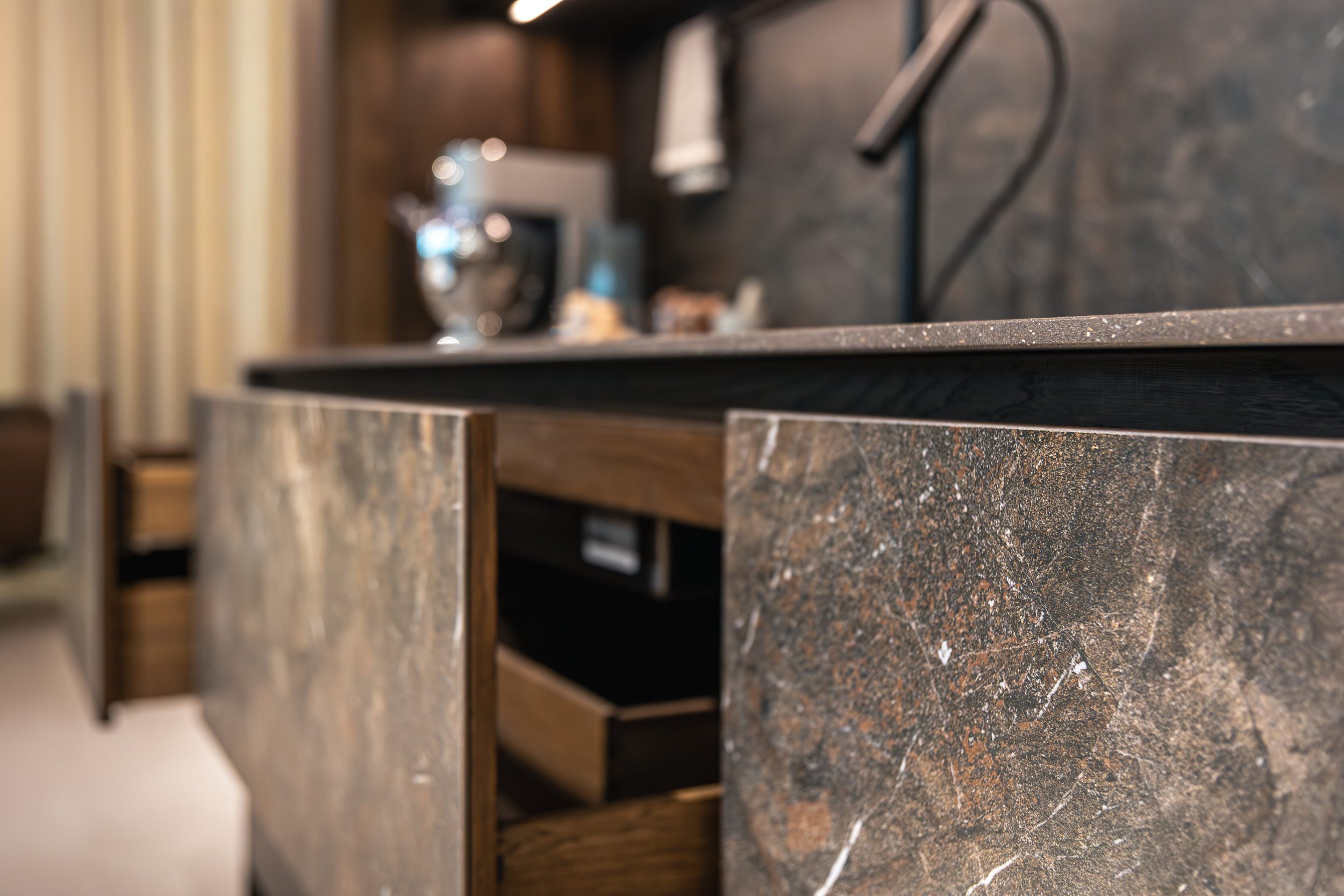
Slabs are available in large format sizes — up to 128 by 56 inches in many collections — and in thicknesses of 4mm (ultra-thin, used for cladding), 8mm (standard for specific applications), 12mm, and 20mm (the standard countertop thickness). The surface is available in a wide range of colors and patterns, including convincing reproductions of natural stone, concrete, metal, and wood aesthetics.
What Dekton Actually Does Better Than Most Competing Materials
Dekton's performance claims are not marketing fiction — they are grounded in real material science. Here is what Dekton genuinely excels at:
• Scratch resistance: Dekton has a Mohs hardness rating of approximately 8.5, making it harder than most natural stones including granite (typically 6-7 on the Mohs scale) and significantly harder than marble (3-4). In practical terms, this means Dekton is exceptionally resistant to scratching from knives, abrasive cleaners, and the general wear of kitchen use.
• Heat resistance: Because Dekton contains no resins, it does not have the thermal vulnerability of engineered quartz. Placing a hot pan directly on a Dekton surface will not cause the discoloration or surface damage that can occur with quartz. The material is genuinely heat-resistant in the practical kitchen sense — not just to warm items, but to temperatures that would damage other surfaces.
• UV resistance: Dekton will not fade, yellow, or discolor from UV exposure. This makes it one of the few countertop materials that performs equally well outdoors as indoors — no color shift, no degradation in direct sunlight. For outdoor kitchens, roof terraces, pool surrounds, and any exterior application, this is a genuine differentiator.
• Stain resistance: The ultra-low porosity of Dekton means it does not absorb liquids in the way that natural stone does. Wine, coffee, oils, and even certain chemicals that would stain or damage marble, granite, or quartz are easily wiped away from a Dekton surface without leaving a trace.
• Freeze-thaw resistance: For outdoor applications in Rhode Island, where temperatures swing from summer heat to genuine winter cold, Dekton's resistance to freeze-thaw cycling is a significant practical advantage. Most natural stones and some engineered surfaces can suffer surface damage from moisture expansion in freeze conditions; Dekton is essentially immune.
The Honest Limitations of Dekton Every Homeowner Should Know
Dekton's strengths are real, but so are its limitations. A complete picture requires acknowledging both:
• Brittleness: This is the most significant practical limitation of Dekton, and the one most often underexplored in showroom conversations. Dekton's extraordinary hardness comes at the cost of flexibility — it is a brittle material that can chip at edges and corners under impact stress. A heavy object dropped at the edge of a Dekton countertop can chip the surface in a way that would leave granite or quartzite completely unaffected. Once chipped, Dekton edge damage is very difficult to repair invisibly. This is not a reason to avoid Dekton, but it is a reason to choose a more protective edge profile and to be thoughtful about how overhangs and unsupported spans are managed.
• Fabrication complexity: Dekton requires diamond-blade cutting and specialized CNC fabrication equipment. Not all fabricators are equipped or experienced to work with it effectively. Working with an inexperienced fabricator on a Dekton installation significantly increases the risk of material damage during cutting, chipping at cutouts for sinks and fixtures, and cracking during transport or installation. Always verify that your fabricator has specific, demonstrated Dekton experience.
• Seam visibility: Because Dekton has a very consistent, manufactured aesthetic (rather than the natural variation of stone), seams between slabs can be more visually noticeable than in natural stone installations where seams can be placed in veining. In large kitchens requiring multiple slabs, seam placement and management requires careful planning.
• Edge profile limitations: The brittleness of Dekton limits the range of edge profiles that can be safely applied. Highly ornate profiles — deep ogees, complex dupont edges — are generally not recommended for Dekton because the thin sections of the profile are vulnerable to chipping. Eased, beveled, and mitered edges are the standard choices.
• Cost: Dekton sits in the premium tier of countertop pricing — typically comparable to or above high-end natural stone. The material cost, combined with the specialized fabrication requirements, means Dekton installations represent a significant investment.
"Dekton is genuinely exceptional at what it does — but knowing exactly what it does and doesn't do is what determines whether it's the right choice for your specific kitchen."
Who Is Dekton Actually Right For?
Given its unique combination of strengths and limitations, Dekton tends to be the right choice in a fairly specific set of applications:
• Outdoor kitchens and exterior applications: This is where Dekton is most clearly in a category of its own. The combination of UV resistance, freeze-thaw resilience, heat tolerance, and stain resistance makes it close to the ideal outdoor countertop material for New England conditions.
• High-use commercial-style kitchens: In kitchens where hot pans are regularly placed on the counter, where abrasive cleaning is part of the routine, and where stain resistance is paramount, Dekton's performance profile matches the demand well.
• Contemporary design applications: Dekton's large-format slabs and clean, manufactured aesthetic are well-suited to minimalist, contemporary kitchen designs where visual consistency and architectural scale are priorities.
• Fireplace surrounds and feature walls: Dekton's heat and UV resistance, combined with its large-format availability, make it a strong choice for interior architectural cladding applications beyond just countertops.
For homeowners renovating older Rhode Island homes with a traditional or transitional aesthetic, Dekton is generally not the most natural fit — the material's manufactured consistency can feel at odds with the organic character of historic architecture, and the edge profile limitations can restrict the traditional edge options that work best in period kitchens.
The Bottom Line on Dekton
Dekton is a remarkable material that performs at the highest level in a specific set of scenarios. It is not a universal countertop upgrade — it is a specialized tool for situations where its unique combination of properties provides genuine value. Understanding those situations clearly, and matching the material to the actual demands of your specific project, is the key to making a decision that holds up over years of actual use.
At East Coast Surfaces, the team can walk you through the full range of surface options — natural stone, engineered materials, and ultra-compact surfaces like Dekton — and help you map each material's real-world performance profile against the demands of your specific project. Explore all surface options, check out the 2026 Trend Report for the latest material directions, and contact the team to discuss what your project actually needs.