Why Countertop Edges Chip And Which Edge Profile Is Most Durable?
I consult on countertops for commercial and residential spaces across the Northeast corridor, and after decades of observing people pick out edges, I am going to break this down in plain English. No bullshit.
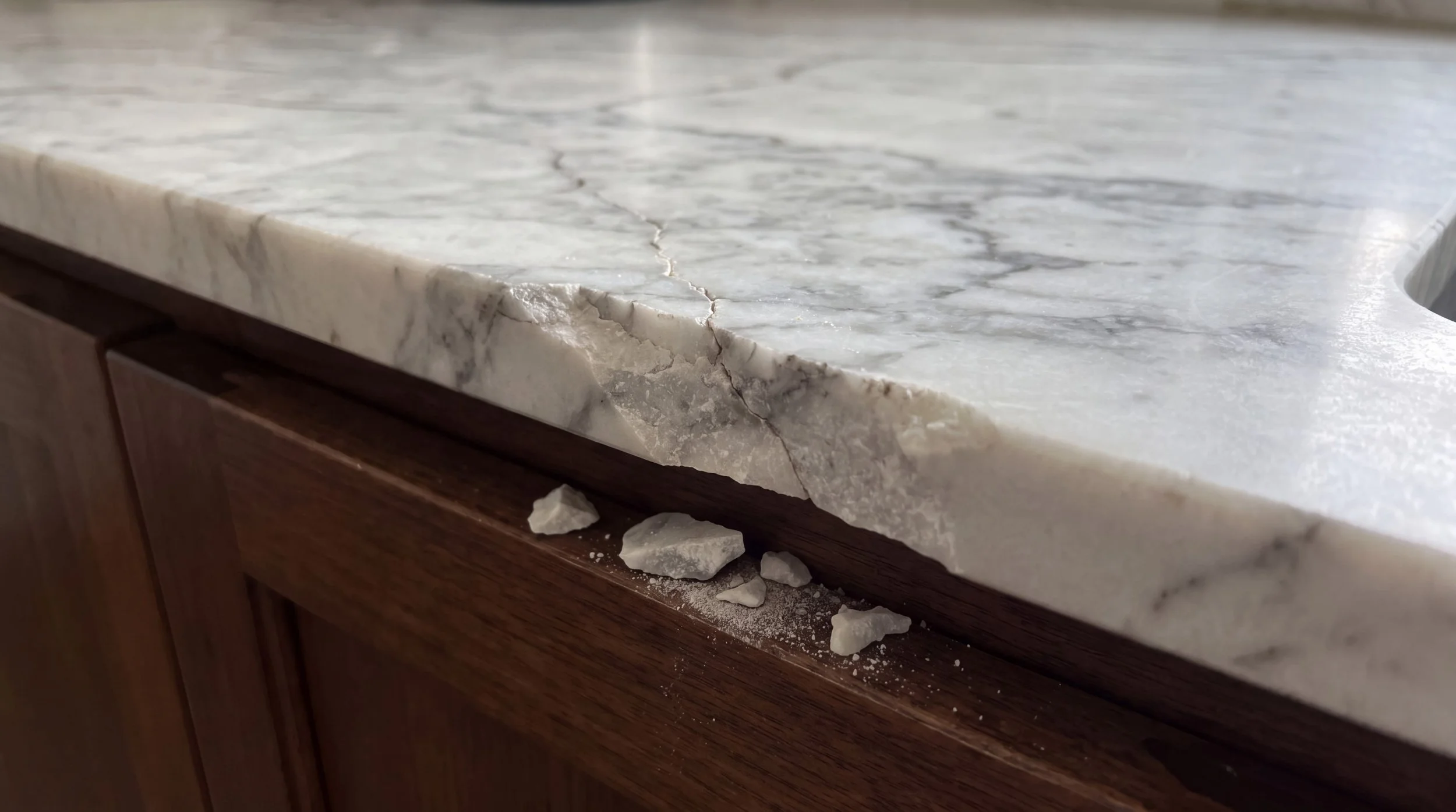
Countertops chip along their edges at rates that vary wildly based on the actual structure of those edges. Nobody buys countertop materials with this idea in mind. They choose colors, slabs, and styles. They do not consider what happens next what their edge profile means structurally.
How Edge Chipping Occurs
Natural stone and engineered materials are all crystalline compounds in varying forms. They resist downward compressive force incredibly well but are highly prone to fracturing when subject to lateral shock. Every single edge profile gets impacted over time, whether by pots falling off stove tops, knives banging down on cutting surfaces, kids running chairs into islands. What differs between edge profiles? How that shock load transfers through the stone structure. A sharp edge allows a concentrated energy impact against a tiny fraction of the stone. This results in extreme localized force, exceeding the tensile limit of the material, causing instant cracking and fracture. Rounded edges diffuse shock loads evenly across a much greater crosssectional area of stone lowering the peak stress past fracture level. Impact resistance follows basic engineering principles.
The Most Vulnerable Edge Profiles
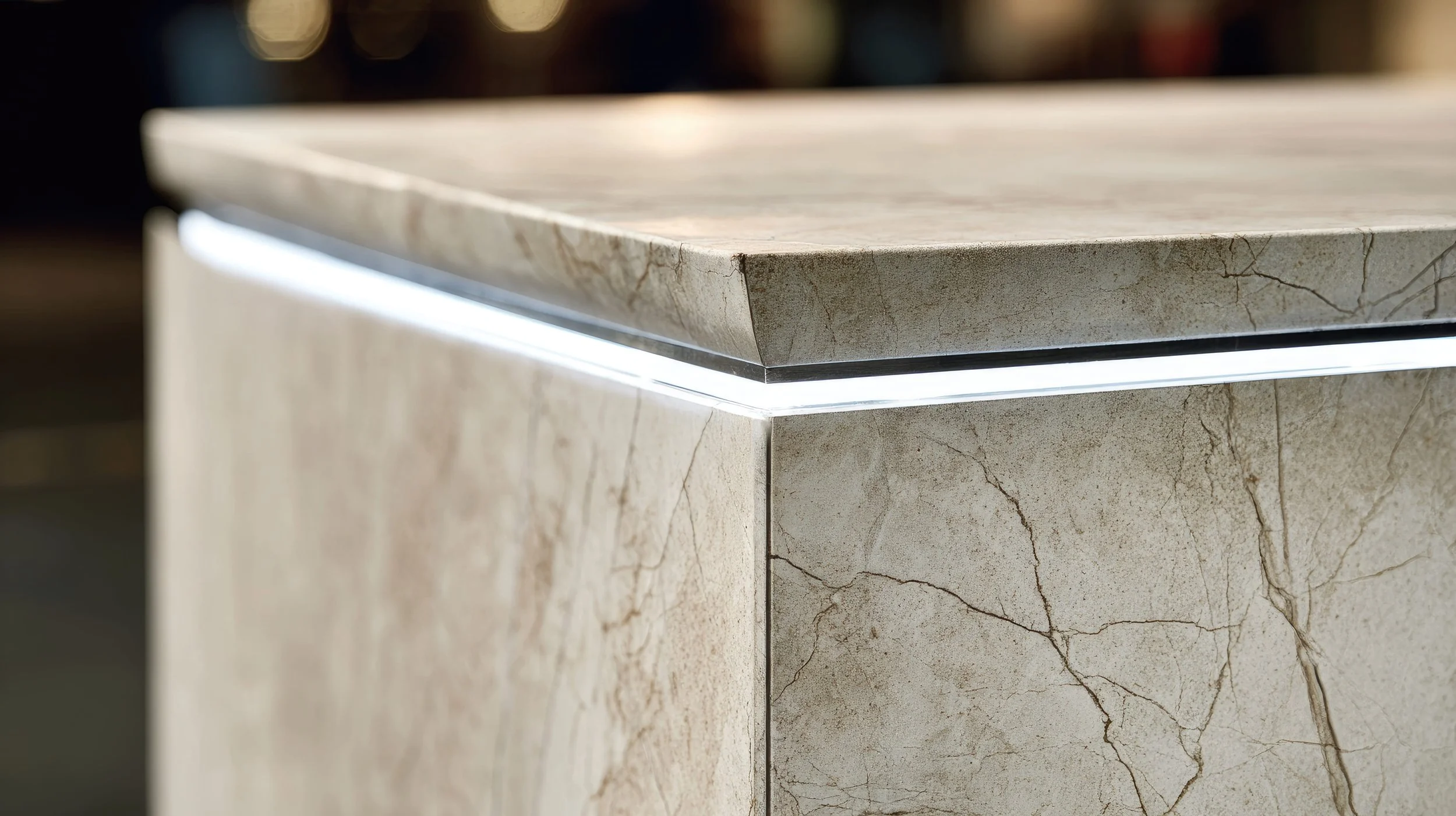
Mitered / waterfall edge (knife edge): Absolutely gorgeous modern look. Also the most fragile possible edge structure in terms of mechanics, since the knife shape presents maximum exposure of vulnerable crystal. Perfect when low impact contact is expected; illadvised for daily-use countertop installations.
Eased edge (square with slight softening): More robust than a pure knife edge due to a slight radius, but still exposing maximum force at a critical point where a square corner remains. Decent choice in low-impact settings, but marginal for daily household use. Chiseled / hand-carved edge: Deliberately irregular in nature, distributing stress in unpredictable ways based on random variations. Suitable outdoors where there is no chance of damage being seen.
Impact-Resistant Edge Profiles
Full bullnose: Most reliable option available against shock loads. Convexly rounded shape deflects impact forces away from critical fracture plane.
Half bullnose (demi bullnose): Top portion fully rounded like the full bullnose; base retains flat plane. Almost equal resilience to impact shocks, but better aesthetic appeal. Ogee: Despite its decorative form, the sweeping S-shaped geometry spreads energy effectively throughout the structure, making it quite resilient to impacts. Face thickness adds additional impact resistance compared to appearance.
Beveled edge: Flat faceted shape cut at a 45-degree angle. Reduces concentration risks while retaining sharp lines, making it one of the best contemporary choices available.
"If you want impact-resistance, treat your edge profile as an engineering problem. Choose based on performance as well as appearance."
Factors That Affect Edge Impact Resistance
Material type does play a key role here albeit indirectly. Hardness levels correlate poorly to resilience against edge impacts, as hardness and toughness are two separate properties. Granite tends to handle edge impacts fairly reliably across most profiles, for example, whereas marble softer and crystal-based chips much easier in thin-edge configurations.
Hence why bullnoses are commonly recommended with marble materials.
Engineered quartz fares extremely well due to reinforced polymers, with binder resins conferring an additional degree of flex and toughness compared to natural materials. Dekton and porcelain, despite their incredible hardness ratings, retain low levels of toughness thus tend to chip easily when used in sharp edge forms. Their manufacturers strongly advise bullnosing whenever possible.
Repairing Chipped Edge Profiles
Most stone chips can be restored successfully via color-matched epoxy injection, if executed correctly. The result looks virtually seamless visually. While this addresses aesthetic concerns rather than reinforcing underlying weaknesses in the edge geometry, at least it buys owners time until a true redesign can occur. Deeper cracks may necessitate full replacement of sections.
Edge Options for Your Project
We work with every imaginable edge geometry across all major countertop materials at ECS. Our specialists regularly counsel clients who seek both visually appealing designs and functional longevity. Check our edge and corner options, our complete stone lineup, and talk to us about which edge configuration suits yours best.