Why Porcelain Countertops Are BecomingPopular in Modern Kitchens
A few years ago, porcelain countertops were a curiosity — a material mentioned occasionally in design publications, used in a handful of avant-garde European kitchens, and largely unfamiliar to American homeowners who associated porcelain primarily with bathroom tile and dinnerware. Today, porcelain slabs are one of the fastest-growing categories in the premium countertop market, appearing with increasing frequency in everything from high-design contemporary homes to thoughtfully renovated older properties where their specific combination of properties solves real problems.
The rise of porcelain as a countertop material is not a trend driven by novelty or marketing. It is a response to a genuine set of performance needs that other materials address imperfectly — and it represents a meaningful technological advance in what fired ceramic products can achieve at scale. Understanding why porcelain has emerged as a serious countertop option, and who it's actually right for, requires looking at what the material actually is and what it actually does.
What Modern Countertop-Grade Porcelain Actually Is
The porcelain used in modern countertop applications is categorically different from the ceramic tile used in bathrooms and backsplashes. Countertop-grade porcelain — often called porcelain slab or sintered stone — is produced through a manufacturing process that fires a mixture of refined clays, feldspar, silica, and mineral oxides at temperatures exceeding 1200 degrees Celsius (over 2200 degrees Fahrenheit) under extremely high pressure. This process — sintering — fuses the materials at the molecular level, creating a surface with a density and hardness that standard ceramic tile simply cannot achieve.
The resulting material has a water absorption rate of less than 0.5 percent — making it essentially impervious to liquids — and a surface hardness that rivals or exceeds many natural stones. It can be produced in large-format slabs of up to 126 by 63 inches (and larger in some product lines), making it viable for full countertop installations with minimal seams, as well as for wall cladding, flooring, and exterior applications.
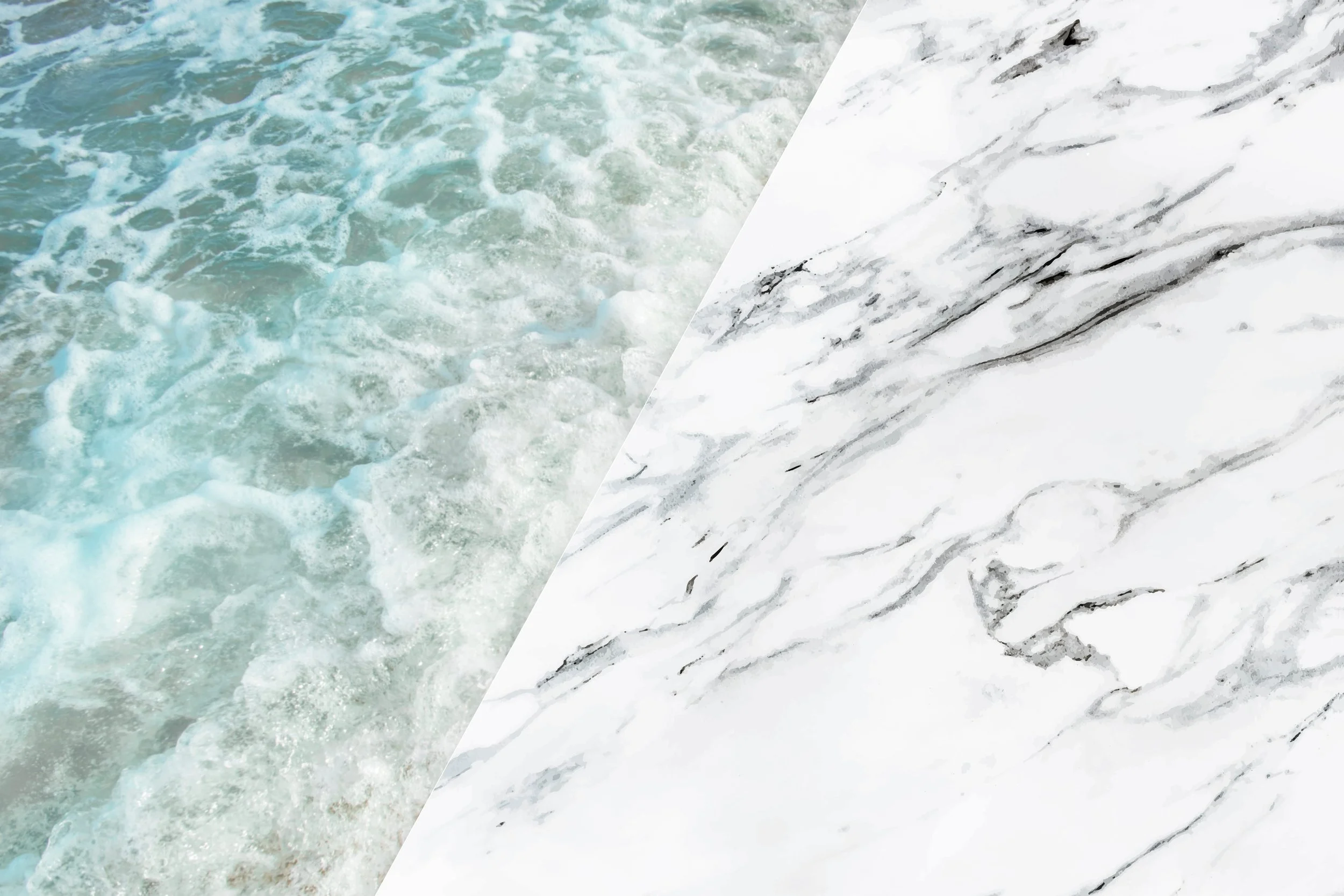
The surface decoration is applied through high-definition digital inkjet printing technology that can reproduce natural stone patterns — Carrara marble, slate, concrete, wood grain — with remarkable fidelity, as well as create entirely original aesthetic directions that natural stone cannot produce. The decoration is fired into the surface rather than applied as a topcoat, making it essentially permanent and resistant to the UV fading that affects surface-applied finishes.
The Six Reasons Porcelain Is Gaining Ground in Modern Kitchens
1. Genuinely Non-Porous Without Resins
Unlike engineered quartz — which achieves its non-porosity through polymer resins — and unlike natural stone — which requires sealing to minimize porosity — porcelain is non-porous at the material level, with no chemical additives required to achieve or maintain that property. It never needs sealing, never absorbs liquids, never stains from oils, wine, coffee, or acidic substances, and can be cleaned with virtually anything including bleach and harsh chemical cleaners that would damage natural stone or degrade quartz resins.
2. UV Stability for Outdoor and South-Facing Applications
Porcelain does not fade, discolor, or degrade in sunlight. The mineral pigments fired into the surface are stable across the full UV spectrum — which means porcelain performs identically in an outdoor kitchen, a sunroom, or a south-facing kitchen with direct sun exposure as it does in an interior room with no natural light. This is a significant advantage over engineered quartz, whose resin components can yellow or degrade with prolonged UV exposure.
For Rhode Island homeowners renovating outdoor kitchens or coastal-facing kitchen spaces that receive significant sun through large windows, porcelain's UV stability removes a practical concern that affects other premium materials.
3. Exceptional Heat Resistance
Because porcelain is fired at over 1200 degrees Celsius during manufacturing, it is, by definition, immune to the temperatures generated by any domestic cooking surface. Hot pans, baking sheets pulled directly from the oven, cast-iron skillets from the range — none of these will damage a porcelain surface. This is one of the clearest practical advantages over engineered quartz, which carries explicit manufacturer warnings against direct hot pan contact.
4. Thin-Profile and Large-Format Versatility
Porcelain is available in thicknesses from 6mm to 20mm, and in large-format slab sizes that allow architectural-scale applications with minimal seams. The thinner profiles (6mm and 8mm) are used primarily for cladding, wall panels, and overlay applications where adding significant weight is not desirable. The standard 12mm and 20mm thicknesses are used for countertop installations and offer a clean, architecturally precise aesthetic that suits contemporary kitchen design extremely well.
The large-format capability is particularly compelling for kitchen islands and long, unbroken countertop runs — applications where natural stone would require carefully managed seams and porcelain can produce a dramatically clean, continuous surface.
5. Consistent Pattern Matching and Repeatability
Unlike natural stone — where each slab is unique and pattern matching across a large installation requires careful selection and sometimes compromise — porcelain's manufactured consistency means that multiple slabs from the same production run will match precisely. For homeowners who value visual predictability and pattern consistency, particularly in contemporary designs where a single unbroken aesthetic direction is important, this reproducibility is a significant advantage.
6. Scratch and Impact Resistance (With an Important Caveat)
Countertop-grade porcelain is extremely hard on the Mohs scale — typically rating between 7 and 8 — making it highly resistant to scratching. However, its hardness comes with the same trade-off seen in other ultra-hard materials: brittleness. Porcelain can chip at edges and corners under sharp impact in ways that softer but tougher materials would resist. Proper edge profile selection and avoiding overhangs without adequate support are important considerations in any porcelain installation.
"Porcelain brings an almost architectural quality to a kitchen — clean, precise, and utterly uncompromising in its performance."
Where Porcelain Fits Best — and Where Other Materials Still Win
Porcelain is an excellent choice in the following scenarios
Contemporary, minimalist, or Scandinavian-influenced kitchens where clean lines, consistentpatterns, and architectural precision are central to the design vision
Outdoor kitchen countertops and surfaces exposed to direct sunlight, frost, or temperature extremes
Large, seamless island tops where a continuous, unbroken surface is aesthetically important
Homeowners who want the visual appearance of marble or concrete without any of thosematerials' maintenance requirement
Commercial applications and high-traffic kitchens where chemical cleaning and maximum stainresistance are priorities
Porcelain is likely not the best choice when:
The kitchen has a traditional, historic, or organic aesthetic where natural stone's authenticvariation and warmth is more contextually appropriate
The homeowner wants the genuine uniqueness of a natural geological material rather than amanufactured reproduction
Complex edge profiles (deep ogees, ornate traditional moldings) are desired — porcelain'sbrittleness limits edge profile options
Budget is a primary constraint — high-quality porcelain slabs and their specialized installationrepresent a premium investment
For homeowners exploring the full range of modern kitchen surface options — from premium natural stone to engineered quartz to large-format porcelain — East Coast Surfaces offers both the material knowledge and the fabrication expertise to help you make the right call for your specific project. Explore all surface options, see current design directions in the 2026 Trend Report, and contact the team to talk through whether porcelain is right for your kitchen.