You walk into a stone showroom — or scroll through a countertop supplier's website — and you see two slabs side by side, both labeled quartz, both roughly the same size, both presented as kitchen countertop options. One is priced at $55 per square foot installed. The other is $130. They look similar at first glance. Both are smooth. Both are hard. Both are non-porous. So what, exactly, is the $75 difference buying you?
This is one of the most common — and most reasonable — questions homeowners ask when beginning a countertop renovation, and it almost never gets a satisfying answer. Most sales conversations default to vague language about 'quality' and 'brand' without explaining the specific, concrete differences that actually justify price variation in the engineered quartz category. The result is that homeowners either overspend on premium branding they don't fully understand, or underspend on budget quartz and discover the difference in ways they didn't anticipate — years into the installation.
Engineered quartz countertops are one of the most popular kitchen surface choices in Rhode Island and across the country, and the price range within the category is genuinely wide — wider than most homeowners expect before they begin shopping. Understanding what drives that range is not just academically interesting; it is practically valuable. It lets you make an informed decision about where on that spectrum your project should sit, based on your actual priorities and your actual kitchen, rather than on marketing language or the particular enthusiasm of a salesperson on a given day.
Here is the complete picture of what actually determines quartz countertop pricing — from the raw material composition to the manufacturing process, the pattern complexity, the slab dimensions, the brand investment, and finally the fabrication and installation work that transforms a raw slab into a finished kitchen surface.
Factor 1: Quartz Content Percentage — The Foundation of Material Quality
Engineered quartz is not a single, consistent material — it is a category of manufactured stone products that share a basic composition but vary significantly in the ratio of natural quartz to the binders, resins, and pigments that hold the product together. This ratio is the single most important determinant of the raw material quality and durability of any given quartz slab.
Premium engineered quartz slabs typically contain between 90 and 95 percent natural quartz crystals by weight. Quartz — silicon dioxide — is one of the hardest and most abundant minerals on earth, with a Mohs hardness rating of 7. At 90–95 percent content, the resulting slab inherits a very significant share of that hardness, density, and non-porosity from the quartz itself. The polymer resins that bind the crystals together are present in a relatively small proportion, which means the material's performance is dominated by the mineral rather than the binder.
Budget quartz products, by contrast, often contain meaningfully lower quartz percentages — sometimes 70 to 80 percent — with a higher proportion of resins and fillers making up the difference. This matters in several practical ways: lower quartz content typically means slightly reduced hardness and scratch resistance, somewhat higher susceptibility to staining over time as the resin matrix is more exposed, and in some products a visual quality that reads as slightly flat or plastic-like compared to high-quartz-content alternatives.
Manufacturers rarely advertise their exact quartz content percentages on showroom materials, which means this distinction is largely invisible to a casual shopper. A knowledgeable supplier will know which products in their inventory carry high quartz content — and will be able to explain the difference honestly.
Practical Insight: When comparing two quartz products at very different price points, ask the supplier directly about quartz content percentage. High-quality manufacturers like Cambria, Caesarstone, and Silestone publish this information as a selling point because it genuinely differentiates their product.
Factor 2: Resin Quality and Composition — The Binder That Holds It All Together
The polymer resins that bind quartz crystals into a solid slab are not all created equal. The quality, chemical composition, and purity of these resins have a direct impact on several aspects of the finished product that matter in daily kitchen use: heat resistance, UV stability, long-term color consistency, and resistance to chemical degradation.
In premium engineered quartz products, the resins are formulated specifically to minimize yellowing under UV exposure, resist the thermal stress of kitchen use, maintain consistent color over decades, and bond with the quartz crystals at a molecular level that maximizes the density and uniformity of the finished slab.
In lower-cost quartz products, the resins are often more generic polymer formulations that perform adequately in the short to medium term but can show their limitations over a longer timeline. The most common manifestation of resin degradation in budget quartz is yellowing — a gradual shift in color, particularly in white and cream products with significant sun exposure, that becomes more pronounced over years. This is not a catastrophic failure; it is a slow, subtle change that accumulates over time and is largely irreversible.
For kitchens with significant southern or western sun exposure — a common reality in Rhode Island homes — resin quality becomes a particularly important consideration when evaluating quartz products at different price points. A premium quartz slab that maintains its bright white tone for 15 years is a meaningfully better investment than a budget slab that begins to shift toward cream after seven.
Factor 3: Pigment Quality and Pattern Design Complexity — The Visual Premium
The visual appearance of an engineered quartz slab is not an accidental byproduct of the manufacturing process — it is designed. Color, pattern, veining movement, depth, translucency, and the relationship between background tone and decorative elements are all the product of deliberate design decisions that vary enormously across the price range.
At the budget end of the market, quartz patterns tend to be relatively simple: a consistent color field with uniform speckling, or a basic printed vein pattern applied in a single pass. These products look clean and consistent on a counter, but they lack the depth, complexity, and visual realism that higher-end products achieve.
Premium quartz manufacturing incorporates several techniques that significantly increase pattern complexity and visual quality:
• Multi-layer pigment application: Rather than a single color pass, premium products build up color in multiple layers — a background tone, a secondary color distribution, and decorative elements applied in a third or fourth pass — creating depth that reads differently from different angles and distances.
• Mirror-accurate stone reproduction: Top-tier quartz products invest heavily in digital scanning technology that captures actual natural stone specimens — specific slabs of Calacatta marble, Statuario — and reproduces their patterns with extraordinary fidelity. The veining movements, color gradients, and mineral texture of these products are genuinely convincing at close range.
• Variable vein thickness and direction: Real stone veins are not uniform lines. They vary in thickness, change direction, feather at the edges, and sometimes branch or merge. Premium quartz products replicate this variability; budget products produce veins that look mechanical and repetitive under scrutiny.
• Translucency effects: Some premium quartz products incorporate glass or mirror fragments, luminescent minerals, or translucent quartz crystals that create a surface with internal depth — a quality that light seems to enter rather than simply reflecting from. This effect is only possible with high-quality ingredient selection and manufacturing precision.
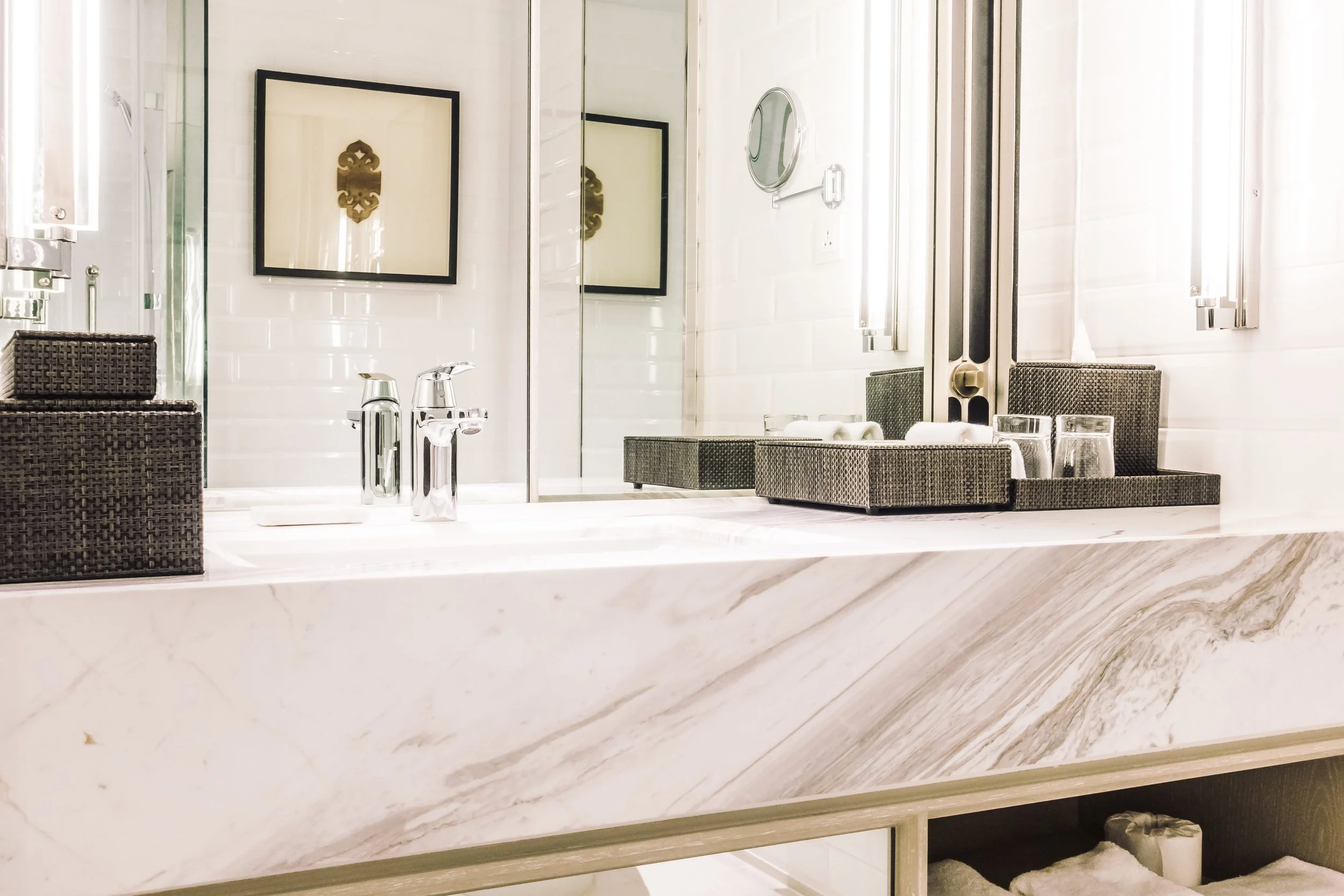
"Budget quartz looks at its best in a showroom photograph. Premium quartz looks better every time you look at it — under morning light, evening candles, and everything in between."
Factor 4: Slab Dimensions and Thickness — Size Matters More Than You Think
Not all quartz slabs are the same size, and the dimensions of a slab affect both its cost and its practical usability in a kitchen installation in ways that are not immediately obvious to a homeowner comparing price tags.
Standard quartz slabs from mainstream manufacturers typically measure approximately 120 inches by 55 inches — adequate for most residential kitchen configurations but not without limitations in very large or complex layouts. Premium manufacturers increasingly offer jumbo or large-format slabs measuring 130 by 65 inches or more, which provide several important advantages:
• Fewer seams in large kitchens: A larger slab can cover more linear footage of counter without requiring a joint. In a kitchen with a long island run or an extended L-shape, a larger slab may eliminate a seam entirely — improving both aesthetics and structural integrity.
• More flexible cut optimization: Larger slabs give the fabricator more options for how pieces are cut from the raw material, which can allow better pattern matching across different sections of the kitchen and more efficient material use.
• Better material for feature applications: Large-format slabs are increasingly used for waterfall islands, full-height backsplashes, and accent walls where a standard-sized slab would force awkward jointing.
Thickness is the other dimensional variable, and one of the clearest visual indicators of countertop quality. Quartz slabs come in two standard thicknesses: 2 centimeters (approximately 3/4 inch) and 3 centimeters (approximately 1-1/4 inch). The price difference between these thicknesses is meaningful — manufacturing a thicker slab requires more raw material, more pressing capacity, and longer curing time — and the visual impact is significant.
A 3CM slab has a visual presence and substance at the front edge of a countertop that immediately reads as premium. The edge face of the stone — what you see when you stand at the counter — is deep and solid, conveying weight and quality. A 2CM slab at the same edge looks noticeably thinner and, unless a laminated build-up is added (which adds cost and, if done poorly, introduces a visible seam at the edge), communicates a lighter-duty material regardless of the quality of the stone itself.
Thickness Standard: Leading fabricators work primarily with 3CM slabs as the baseline for residential countertop installations — because the visual and structural advantage over 2CM is significant enough to be the right default for any project where quality is a priority.
Factor 5: Manufacturing Precision and Quality Control — Where Premium Producers Invest Heavily
Premium quartz manufacturers invest substantially in the precision of their manufacturing processes — in ways that are genuinely expensive to implement and that produce measurable differences in the consistency and quality of the finished slabs. These investments are reflected directly in the retail price of the product.
• Pressing consistency: The pressing stage — where the raw quartz mixture is compressed under high pressure to form the slab — requires precision to produce a product of uniform density throughout. Inconsistent pressing can create internal voids or density variations that affect both the visual appearance and structural performance of the finished slab.
• Surface flatness and dimensional accuracy: A premium slab is guaranteed to be flat within very tight tolerances — typically less than 1mm variation across the full length. Slabs with surface variation beyond acceptable tolerances require shimming and adjustment during installation that adds complexity and can affect the final appearance.
• Calibration consistency: Calibration refers to the uniformity of thickness across the full slab. A well-calibrated slab is the same thickness at every point; a poorly calibrated slab has variations that create uneven cabinet support and can result in a countertop that requires excessive shimming to level.
• Post-pressing surface treatment: Premium quartz manufacturers apply multiple surface finishing passes — grinding, polishing, and buffing — that produce a surface consistency and sheen depth that budget products cannot replicate. A premium polished quartz surface has a depth and richness that reads as genuinely high-quality; a budget surface can look slightly flat or mechanical by comparison.
Factor 6: Brand Investment and Warranty Coverage — What You're Buying Beyond the Slab
A meaningful portion of the price premium in high-end quartz brands reflects investment in areas beyond the slab itself — warranty programs, quality certification, design investment, and the infrastructure of product support that provides value over the lifetime of the installation rather than just at the point of purchase.
Leading quartz manufacturers like Cambria (American-made, family-owned), Caesarstone (established 1987), and Silestone (Cosentino Group) offer lifetime warranties on their residential products — warranties that cover manufacturing defects, color consistency, and in some cases structural failure, for the life of the installation. These warranties are backed by established, financially stable companies with the infrastructure and intent to honor them.
Budget quartz brands — often private-label products manufactured in lower-cost facilities without the same quality oversight — typically offer shorter, more limited warranties. When a budget quartz slab develops a manufacturing defect at year four, the warranty conversation can be considerably more complicated than it would be with an established premium brand. Beyond warranty, established brands continuously invest in new patterns, improved manufacturing techniques, and updated color ranges — producing better products and ensuring those products remain supported throughout the lifecycle of your installation.
Factor 7: Fabrication Quality — The Part Most Homeowners Don't Factor In
Here is the variable that most homeowners overlook when comparing quartz prices: the fabrication and installation work that transforms a raw slab into a finished countertop is not the same across all shops, and the cost difference between quality fabrication and discount fabrication is as real — and as visible — as the difference between premium and budget materials.
Quartz fabrication requires precision CNC cutting equipment, skilled operators, careful template measurement, expert edge profiling, and a meticulous installation process. When you see a price quote that seems very low for a quartz installation, it is worth understanding exactly where that economy is being achieved. The possible answers include:
• Lower-grade material: A less expensive base product that may perform differently over time
• Reduced templating precision: Less thorough measurement that can result in gaps, overhangs, or misaligned seams
• Faster, less careful fabrication: Higher throughput with less attention to cutout quality, edge consistency, and surface finish
• Limited edge profile options: Simpler, faster-to-execute profiles only — no complex ogees, miters, or premium profiles
• Less thorough installation: Less attention to shimming, leveling, and the details of how the stone meets walls, backsplashes, and fixtures
The total installed cost of a quartz countertop should be evaluated as a single number that reflects material quality AND fabrication quality together. A premium slab fabricated by a low-quality shop will not look like a premium installation. A budget slab fabricated by a skilled shop will look better than it otherwise would — but material limitations will still show over time.
The Price Tier Breakdown: What Each Level Actually Delivers
| Price Tier | Typical Installed Range | What You're Getting | Best For |
|---|---|---|---|
| Entry Level | $45–$65/sq ft | Lower quartz %, simpler patterns, standard warranty, basic fabrication | Rentals, short-term renovations, tight budgets |
| Mid Range | $65–$95/sq ft | 85–90% quartz, improved patterns, better resins, quality fabrication | Primary homes, active family kitchens, solid long-term choice |
| Premium | $95–$130/sq ft | 90–95% quartz, high-fidelity stone patterns, premium resins, lifetime warranty | Design-forward kitchens, high-use luxury homes, long-term investment |
| Ultra Premium | $130+/sq ft | Specialty brands, jumbo slabs, most complex patterns, full lifetime warranty | High-end renovations, designer-specified projects, statement kitchens |
The Hidden Cost Factors That Make Two Identical Quotes Very Different
Even when two suppliers quote the same per-square-foot price for what appears to be the same product, the final experience and outcome can differ significantly based on factors that don't appear in the headline number:
• Edge profile inclusion: Some quotes include a basic eased edge; others charge separately for anything beyond a simple straight edge. A complex ogee or waterfall miter profile adds cost that should be explicitly accounted for in any comparison.
• Cutout pricing: The cutouts for undermount sinks, cooktops, and fixtures are sometimes priced separately from the base per-square-foot rate. An apron or farmhouse sink cutout is a significant fabrication task that adds meaningfully to the total cost.
• Overage and material waste: Stone fabrication always involves material waste from cuts, and the way waste is calculated and billed varies by shop. Confirm whether you're paying for the actual square footage installed or for the full slab square footage.
• Removal of old countertops: Not all installation quotes include removal and disposal of existing countertops. If this is required, confirm it's in the quote.
• Backsplash and specialty pieces: Window stools, full-height backsplash sections, and specialty pieces are often quoted separately. Make sure comparison quotes cover identical scopes of work.
"The cheapest quartz quote is never an apples-to-apples comparison with a premium quote. The question is always: what is each number actually including — in material, in
fabrication, and in the outcome you'll live with every day."
The Questions Every Homeowner Should Ask Before Choosing a Quartz Product
Armed with the context above, here is a concrete list of questions to ask any supplier or fabricator when evaluating quartz options at different price points:
What is the quartz content percentage of this product?
Who manufactures this slab, and what warranty do they offer?
Is this a 2CM or 3CM slab, and is the thickness consistent across the slab?
What edge profiles are included in the quoted price, and what costs extra?
Does the quote include removal of existing countertops?
Are sink and cooktop cutouts included, or priced separately?
Can I see completed installation photos — specifically seam work and edge profiles — from your shop?
What is your templating process, and do you use digital or laser templating?
How does this product compare to the alternative you're recommending at a different price?
How to Evaluate True Value — Not Just Price
The fundamental mistake in quartz countertop shopping is evaluating price without simultaneously evaluating value. A quartz countertop installed in your kitchen will be used every single day — looked at, touched, cleaned, leaned on, and lived with — for potentially fifteen to twenty years or more. Over that timeframe, the per-year cost of even a significantly more expensive premium installation is remarkably small.
Consider a kitchen with approximately 50 square feet of counter space. At $65/sq ft (entry level, installed), the total is $3,250. At $110/sq ft (premium, installed), the total is $5,500. The difference is $2,250 — spread over fifteen years of daily use, that is $150 per year, or roughly $12 per month. Against that number, ask whether the differences in pattern realism, color stability, scratch resistance, warranty coverage, and fabrication quality described above are worth $12 per month to you.
For many homeowners — particularly those in primary residences they plan to live in long-term — the answer is clearly yes. For others — landlords, short-term flippers, homeowners on a strict budget — an entry-level quartz from a quality fabricator is entirely appropriate. Neither answer is universally right.
But it should be a deliberate decision based on real information, not a default based on headline price alone.
Beyond Quartz: When the Same Budget Opens Better Alternatives
One final consideration worth raising: for homeowners who find themselves stretched to reach the premium tier of engineered quartz, it is worth having a conversation about whether that same budget opens access to a natural stone alternative that may offer more distinctive visual character and comparable or better long-term value.
A mid-grade granite — harder than quartz, heat-resistant without qualification, and available in genuinely beautiful natural patterns — can often be installed at a price point comparable to premium engineered quartz. A entry-level quartzite — with dramatic natural veining that premium quartz tries to replicate, genuine geological uniqueness that manufactured stone cannot match, and comparable hardness and durability — occupies a similar price tier to many premium quartz products.
Understanding the full range of options — across both engineered and natural stone — is the best starting point for any countertop project. The right material is the one that balances your aesthetic vision, your practical lifestyle, and your budget most effectively — and that decision is almost always better made with complete information than with incomplete information and a strong instinct toward one category.
Summary: The 7 Factors That Explain Quartz Price Differences
| Factor | Price Impact | What to Look For |
|---|---|---|
| Quartz content % | High | 90–95% in premium products |
| Resin quality | High | UV-stable, non-yellowing formulas |
| Pattern complexity | High | Multi-layer, realistic stone reproduction |
| Slab size & thickness | Moderate | 3CM standard; large-format slabs for fewer seams |
| Manufacturing precision | Moderate | Flatness, calibration, surface finish consistency |
| Brand & warranty | Moderate | Lifetime warranty from established brands |
| Fabrication quality | High | CNC precision, skilled installation, seam management |
Finding the Right Quartz for Your Kitchen in Rhode Island
There is no single right answer to what quartz product a homeowner should choose — but there is always a right answer for a specific homeowner, a specific kitchen, and a specific set of priorities. The key is having access to the full range of options and the honest, knowledgeable guidance to navigate between them.
East Coast Surfaces in Cranston, Rhode Island carries over 150 colors and materials across quartz, granite, marble, quartzite, soapstone, and Dekton — including products at multiple price tiers within the engineered quartz category. Their experienced sales team regularly helps homeowners understand exactly what separates the products in their inventory, what each option will realistically look like once installed, and which choice makes the most sense for a specific kitchen and a specific budget.
Rather than navigating the quartz category alone — with manufacturer marketing as your primary guide — it is worth an hour in a showroom where you can see actual slabs, run your hand across different finishes, compare pattern quality side by side at close range, and have a direct conversation about what the price differences actually mean in practice — from someone whose livelihood depends on giving you the right answer, not the most expensive one.
Browse the full surface collection, explore the edge and finish options that affect how any slab looks once installed, check out the 2026 Trend Report for current design directions in quartz and natural stone, and reach out to the team to start the conversation — or stop by the warehouse at 159 Frances Ave, Cranston, RI, Monday through Saturday.